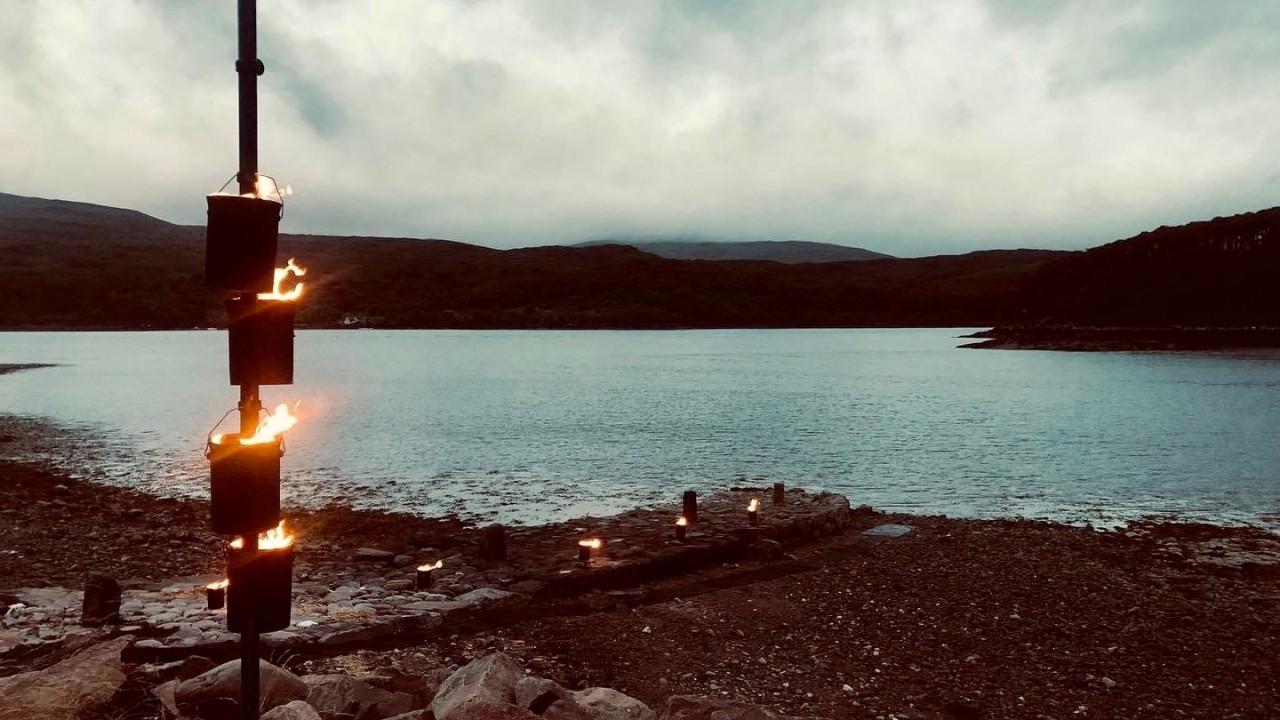
In just a few days’ time I will be standing on the edge of Loch Shieldaig, looking out into cold Scottish water, waiting to start one of the hardest endurance events I have ever taken on: CELTMAN! Extreme Scottish Triathlon.
For those who have never heard of it, Celtman is not simply “an Ironman in Scotland”. It is part of the world of extreme triathlon. The race involves a 3.4km cold-water swim, a 200km bike route through the Highlands, and a marathon-distance run which, if the weather and cut-offs allow, takes athletes into and over the mountains around Torridon.
It sits somewhere beyond the traditional Ironman challenge. Not necessarily because the distances are wildly different, but because the environment changes everything. Cold water. Remote roads. Brutal climbs. Unpredictable weather. Mountain terrain. Navigation. Cut-offs. Support crew. The need to keep making good decisions when your body and brain are both starting to ask awkward questions.
It is a race that does not just test fitness. It tests judgement, humility, resilience, planning, and your ability to accept help.
And that last part feels particularly important this month.
June is widely recognised internationally as Men’s Health Month, with a growing focus on men’s mental health. In the UK, a lot of the public conversation around men’s mental health is still more heavily associated with November and the brilliant work of Movember. But whether the conversation happens in June, November, or on a random Tuesday morning over a cup of coffee, the message matters.
Men are still dying by suicide at disproportionately high rates.
Behind that statistic are fathers, sons, brothers, husbands, colleagues, mates, veterans, athletes, leaders, apprentices, business owners, and people who looked absolutely “fine” until they were not.
That word — fine — does a lot of heavy lifting.
“How are you?”“Fine.”“Everything okay?”“Yeah, fine.”“Are you struggling?”“No, I’m fine.”Sometimes fine means fine. But often, especially for men, it can mean:
“I don’t know how to explain what is going on.” “I don’t want to be a burden.” “I’m embarrassed.” “I should be able to cope.” “I don’t want people to think I’m weak.” “I’m scared that if I say it out loud, it becomes real.”
We are still shaped by a version of stoicism that tells men to push through, keep quiet, crack on, and deal with it alone. There is, of course, a place for resilience. There is a place for grit. There is a place for discipline, self-control, and carrying responsibility.
But there is a difference between strength and silence.
There is a difference between resilience and isolation.
There is a difference between being stoic and slowly disappearing behind a mask.
One of the themes I have been exploring in the build-up to Celtman is “the Ghost”. It came partly from the Valtos song, The Ghost, and the Gaelic line:
“Thig taibhs am follais ge b’ àit an tèid mi” — wherever I go, a ghost appears.
For me, that ghost has a very personal meaning.
It is the shadow of Swissman, where everything seemed to unravel. The difficult journey just to get there. The mechanical issues. The eventual DNF. The frustration of feeling like I had failed at something I cared deeply about. It is also the shadow of Lyme disease, possible neurological symptoms, self-doubt, and the strange experience of training for something enormous while not always feeling fully in control of your own body.
But the more I have thought about it, the more I think many men carry their own ghost.
For some, it is impostor syndrome.
For some, it is depression.
For some, it is anxiety hidden behind humour.
For some, it is loneliness in a busy room.
For some, it is trauma they never had the chance to process.
For some, it is not feeling like they belong anywhere — at work, at home, in their friendship groups, or even in their own skin.
And because so much of this can be invisible, we become very good at performing okayness.
That is why support matters.
In Celtman, you cannot do the race completely alone. You need people around you. You need a support crew. You need people who can see what you cannot see when you are deep in the challenge. People who can notice when your decision-making is slipping. People who can remind you to eat, drink, layer up, slow down, move forward, or stop for a moment. People who can look you in the eye and ask the question properly.
Life is not that different.
We all need people who can check in.
Not just the polite check-in, but the real one.
The person who notices when “I’m fine” sounds different. The person who asks again. The person who says, “I know you’re saying you’re okay, but you don’t seem okay.” The person who does not call you out to shame you, but calls you in because they care. The person who makes it safe to be honest.
That kind of support can change the direction of a day. Sometimes it can change the direction of a life.
I have been incredibly lucky in my own preparation to have Ken, my coach who has helped frame the impossible into something manageable. When the whole event feels too big, the work becomes simple: focus on the next section, the next climb, the next feed, the next decision. Don’t solve the whole bike leg while you are still in the loch. Don’t catastrophise the marathon while you are still on the bike.
That framing has helped me more than I can properly explain.
It is also a useful lesson beyond sport.
When work, home life, pressure, identity, money, relationships, health, and responsibility all pile up together, the whole thing can feel impossible. The instinct can be to minimise it. To tell people it is fine. To wait until things get worse before asking for help.
But support does not have to be a crisis response.
Sometimes support is a safety net. Sometimes it is a check-in. Sometimes it is someone helping you find perspective. Sometimes it is real-world advice about how to manage work, conversations, adjustments, routines, pressure, and expectations before everything tips over.
That is where services like the Access to Work Mental Health Support Service can make such a difference. For people who are working and finding that stress, anxiety, low mood, depression, burnout, neurodivergence, or other mental health challenges are affecting their work, it can provide confidential, practical support. Not as a sign that someone has failed, but as a way of helping them stay in work, manage what is going on, and build a more sustainable way forward.
Because sometimes the strongest thing someone can do is not to keep pushing silently.
Sometimes the strongest thing is to say:
“I’m not okay.” “I need a hand.” “I don’t know what to do next.” “I need someone to help me make sense of this.”
As I head towards Celtman, I know there will be moments where I will have to dig deep. There will be moments where the Ghost turns up. There will be moments where doubt gets loud and the easy thing would be to shrink the truth down into “I’m fine”.
But I also know I will not be doing it alone.
I will have my support crew. I will have my coach’s voice in my head. I will have the lessons from the races that went wrong. I will have the people who have helped me get to the start line. And I will have a reminder that asking for help is not the opposite of strength.
It is part of it.
So during Men’s Health Month, and beyond it, maybe the challenge for all of us is this:
Ask twice. Listen properly. Notice the ghost behind the “fine”. Make it easier for men to speak before they break. And when someone lets you in, treat that trust as something precious.
Because none of us are meant to do the hardest things alone.